(+91) 9445444862
 Info@indbiz.in


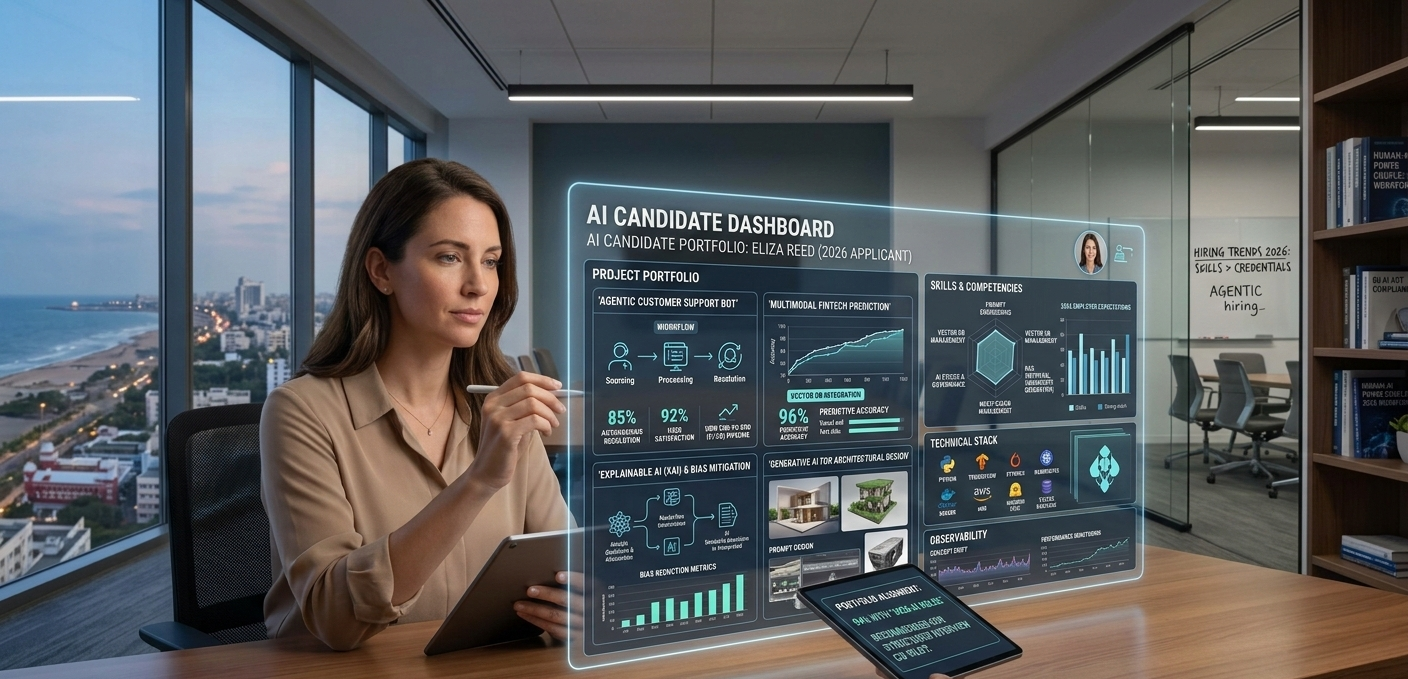
AI Jobs in 2026 are evolving fast. Discover the exact skills US and global employers want, salary trends, and how to prepare strategically.

Introduction
If you’re planning a career in artificial intelligence, you’re probably asking the same question thousands of professionals in the USA, India, Europe, and the Middle East are asking:
What skills will companies actually hire for in 2026?
The AI job market is no longer experimental. It’s strategic. From Silicon Valley startups to enterprise companies in New York, London, and Bengaluru, organizations are no longer hiring “AI enthusiasts.” They’re hiring problem-solvers who can deploy AI at scale.
In this article, we break down AI Jobs in 2026, the exact technical and business skills employers demand, salary insights, and how candidates can stay competitive globally.
Why AI Jobs in 2026 Will Be More Competitive Than Ever
AI adoption has moved from “innovation project” to “core infrastructure.”
Companies in the US are embedding AI into:
- Customer service automation
- Financial risk modeling
- Healthcare diagnostics
- Marketing personalization
- Supply chain optimization
Meanwhile, countries like India are scaling AI talent hubs in cities like Chennai, Bengaluru, and Hyderabad, serving global markets.
By 2026, employers will prioritize:
- Production-ready AI skills
- Deployment experience
- Cross-functional collaboration
- Responsible AI practices
The hiring bar is rising.
The Exact Skills Companies Are Hiring For in 2026
Let’s break this down into practical categories.
1. Core Technical Skills (Non-Negotiable)
🔹 Machine Learning & Deep Learning
Companies expect strong understanding of:
- Supervised & unsupervised learning
- Neural networks
- Model evaluation techniques
- Overfitting & optimization
Popular tools in 2026:
- Python
- TensorFlow
- PyTorch
- Scikit-learn
US employers particularly value candidates who can move from notebook experiments to real deployment pipelines.
🔹 Generative AI & LLM Integration
With the rise of large language models, companies want:
- Prompt engineering expertise
- Fine-tuning models
- Retrieval-Augmented Generation (RAG)
- API integrations
Generative AI is no longer optional — it’s embedded in SaaS, fintech, legal tech, and healthcare.
🔹 Data Engineering Skills
AI professionals who understand data pipelines are in higher demand.
Employers look for:
- SQL & NoSQL
- Data cleaning & transformation
- Cloud storage systems
- ETL workflows
In global markets, candidates who combine AI + data engineering are earning higher packages.
2. AI Deployment & Cloud Skills (High Demand in USA)
In 2026, building a model isn’t enough.
Companies expect:
- AWS SageMaker
- Google Cloud AI
- Azure ML
- Docker & Kubernetes
- MLOps workflows
Key insight:
Candidates with deployment knowledge are 40–60% more likely to get shortlisted in US-based roles.
3. Business & Product Understanding (The Differentiator)
This is where many candidates fail.
Employers want AI professionals who:
- Understand ROI
- Can explain models to non-technical stakeholders
- Align AI systems with business goals
- Measure impact metrics
In global markets, AI professionals who understand product thinking move into leadership roles faster.

Comparison Table: 2023 vs 2026 AI Hiring Expectations
| Skill Category | 2023 Focus | 2026 Expectation |
|---|---|---|
| Machine Learning | Model building | Production deployment |
| Generative AI | Experimental use | Integrated into workflows |
| Cloud Skills | Optional | Mandatory |
| Business Understanding | Bonus | Required |
| AI Ethics | Rarely discussed | Core compliance need |
Step-by-Step: How to Align Your Skills for AI Jobs in 2026
Step 1: Strengthen Foundations
- Master Python
- Understand statistics
- Practice ML algorithms from scratch
Step 2: Build Real-World Projects
Instead of tutorial projects, build:
- AI chatbots for businesses
- Fraud detection demo
- Predictive analytics dashboards
Step 3: Learn Deployment
Deploy models on:
- AWS
- Azure
- Google Cloud
Create a public GitHub portfolio.
Step 4: Study AI Ethics & Compliance
US companies especially require:
- Data privacy understanding
- Bias mitigation
- Model transparency
Step 5: Develop Communication Skills
Be able to explain your model to:
- Product managers
- CEOs
- Clients
This is where many technical professionals lose opportunities.
Benefits of Mastering These Skills
Professionals who prepare strategically for AI Jobs in 2026 can expect:
- ✅ Higher salary brackets
- ✅ Global remote job access
- ✅ Leadership opportunities
- ✅ Faster visa sponsorship chances (US, Canada, UK)
- ✅ Freelancing and consulting income streams
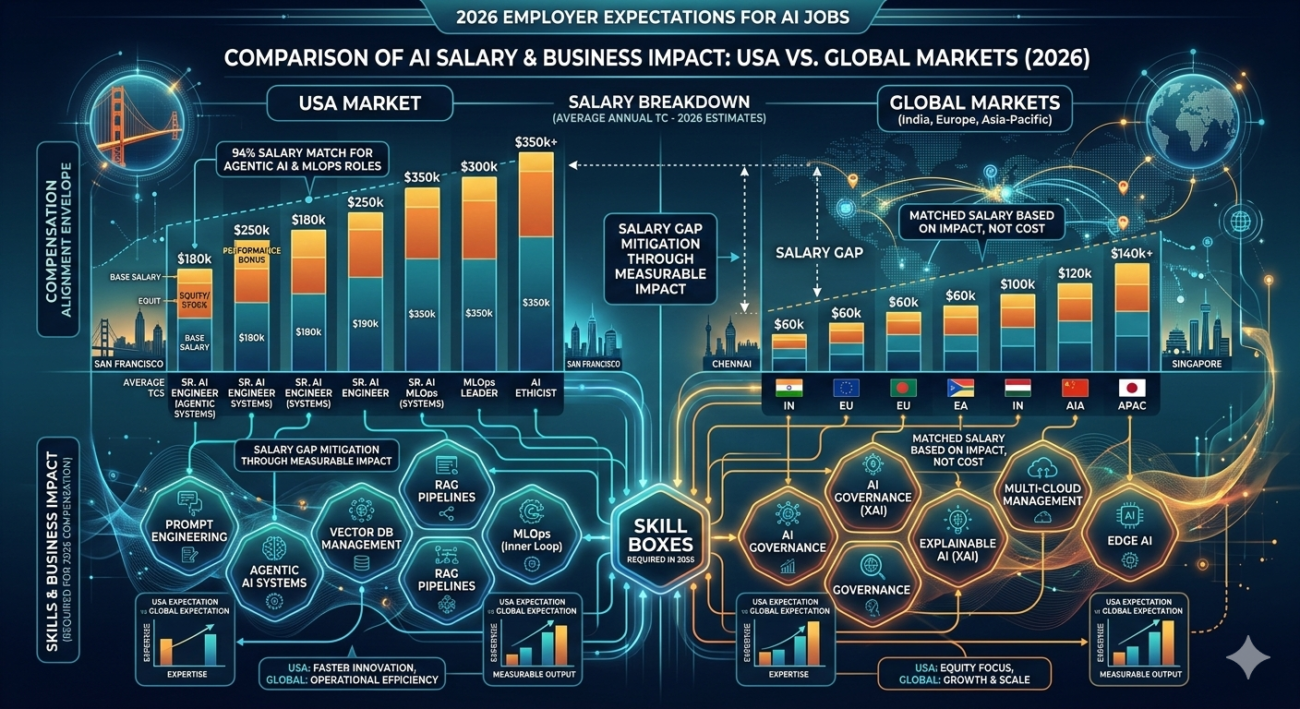
Global Salary Insights (2026 Projection)
| Role | USA Average Salary | Global Average |
|---|---|---|
| AI Engineer | $130,000–$180,000 | $60,000–$110,000 |
| ML Engineer | $120,000–$170,000 | $55,000–$100,000 |
| AI Product Manager | $140,000–$190,000 | $70,000–$120,000 |
| AI Researcher | $150,000+ | $80,000+ |
US compensation remains significantly higher, but remote roles are closing the gap.
USA vs Global Hiring Mindset
🇺🇸 USA
- Strong focus on deployment
- Product-market fit understanding
- AI compliance & regulation
- Communication skills
🌍 Global Markets
- Cost-effective AI talent
- Strong technical foundations
- Growing demand for cloud skills
Candidates targeting US roles must show business impact, not just technical capability.
Common Mistakes Candidates Make
- Only learning theory
- Ignoring cloud platforms
- No real portfolio
- No deployment knowledge
- Weak communication
In 2026, employers reject resumes that lack real-world proof.
FAQ Section
Q: What degree is required for AI jobs in 2026?
A: While a computer science or engineering degree helps, many US employers prioritize skills and project portfolios over formal education.
Q: Are AI jobs in 2026 saturated?
A: Entry-level roles are competitive, but specialized roles in deployment, MLOps, and generative AI are still in high demand globally.
Q: Is certification necessary?
A: Cloud certifications (AWS, Azure, GCP) increase credibility, especially for US-based companies.
Q: Can non-tech professionals transition into AI?
A: Yes, particularly into AI product management, data analysis, and AI strategy roles.
Q: Which country has the highest AI salaries?
A: The United States currently leads in AI compensation, followed by Switzerland, Canada, and the UK.
Q: Will AI replace AI engineers?
A: No. AI tools automate coding assistance, but system design, deployment, and optimization still require human expertise.
Conclusion: Preparing for AI Jobs in 2026 Starts Now
AI Jobs in 2026 will not reward casual learners. They will reward:
- Practical builders
- Cloud-ready engineers
- Business-minded technologists
- Ethical AI practitioners
The next two years will define career trajectories for the next decade.
If you start building real-world projects today, focus on deployment, and develop business understanding, you won’t just compete — you’ll lead.
The AI market is expanding globally. But only prepared professionals will benefit from it.