(+91) 9445444862
 Info@indbiz.in



Preparing for AI Jobs in 2026? Discover employer requirements in the USA and globally, step-by-step preparation strategy, and career roadmap.

Introduction
The biggest mistake professionals make when preparing for AI careers is assuming that “learning AI” is enough.
It isn’t.
In the United States and across global markets, companies are no longer impressed by course certificates or theoretical knowledge. Employers want deployable skills, measurable impact, and cross-functional intelligence.
If you’re serious about securing AI Jobs in 2026, you need to understand how hiring standards are evolving — and how to align yourself accordingly.
This guide reveals exactly what employers expect and how you can prepare strategically.
Why Employer Expectations Are Changing in 2026
AI adoption has matured.
In 2023–2024:
- Companies experimented.
- Teams tested models.
- Hiring was aggressive but exploratory.
By 2026:
- AI must generate ROI.
- Compliance regulations are stricter (especially in the US).
- Deployment speed matters.
- Business alignment is mandatory.
Companies in New York, San Francisco, London, Berlin, Toronto, and Singapore now assess AI candidates based on business execution capability, not just technical depth.
What Employers Require for AI Jobs in 2026
Let’s break this into clear categories.
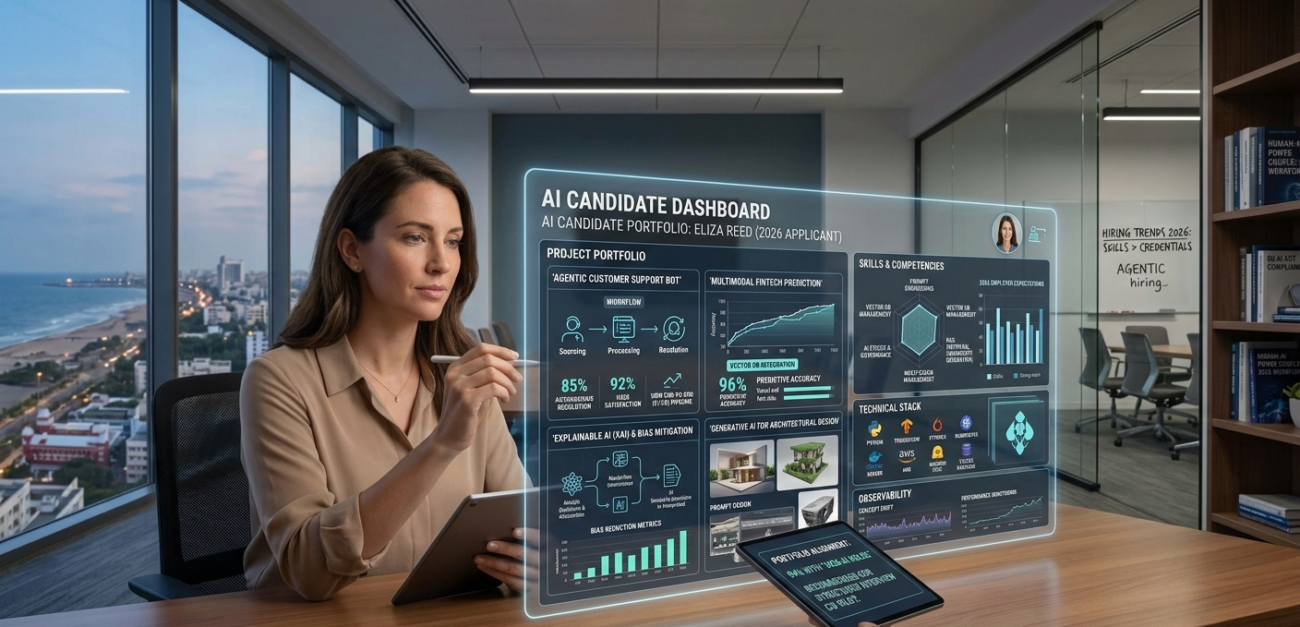
1. Strong Technical Foundations (Still Essential)
Employers expect:
- Python proficiency
- Solid statistics knowledge
- ML algorithms understanding
- Model evaluation metrics
- Data preprocessing mastery
But here’s the difference:
In 2026, interviewers will ask:
- “How did this model impact revenue?”
- “What was the deployment architecture?”
- “How did you handle model drift?”
If you cannot answer beyond theory, you won’t pass.
2. Deployment & MLOps Knowledge (Mandatory in the USA)
US companies prioritize candidates who understand:
- CI/CD pipelines
- Docker & Kubernetes
- AWS / Azure / GCP
- Model monitoring
- Version control for ML models
Global employers are increasingly following this trend.
Key shift:
Building a model = entry-level
Deploying & scaling it = hire-worthy
3. Generative AI & LLM Implementation
In 2026, nearly every SaaS product integrates AI.
Employers look for:
- Prompt engineering
- Fine-tuning LLMs
- RAG pipelines
- API integrations
- Security implementation
Generative AI skills are no longer “extra” — they are foundational.
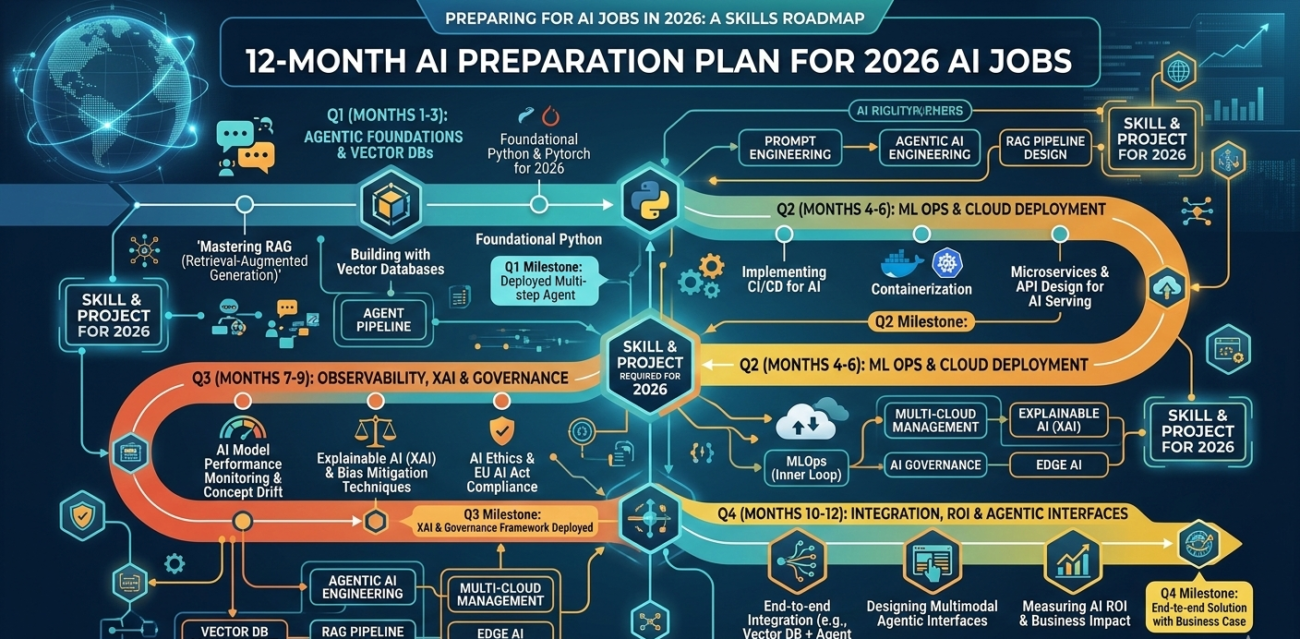
Step-by-Step Roadmap to Prepare for AI Jobs in 2026
Here is a practical plan.
Step 1: Master Core Programming (Months 1–3)
Focus on:
- Python (advanced level)
- Data structures
- NumPy, Pandas
- Scikit-learn basics
Build 3 mini projects:
- Regression model
- Classification model
- Data visualization dashboard
Step 2: Build Real-World Use Case Projects (Months 3–6)
Instead of copying YouTube tutorials, build:
- AI chatbot for small businesses
- Predictive sales model
- Fraud detection demo
- Resume screening tool
Host it publicly:
- GitHub
- Live demo
- Cloud deployment link
This differentiates you immediately.
Step 3: Learn Cloud Deployment (Months 6–9)
Choose one:
- AWS
- Azure
- Google Cloud
Deploy at least:
- One ML model
- One generative AI application
Understand:
- API creation
- Containerization
- Monitoring
This is where most candidates stop. Don’t.
Step 4: Understand AI Governance & Ethics (Months 9–12)
US employers particularly require:
- Bias detection
- Data privacy compliance
- Model transparency
- Responsible AI frameworks
Companies hiring globally now screen for ethical awareness.
Step 5: Develop Business Communication Skills
This is the hidden accelerator.
Learn to:
- Present technical results to executives
- Translate AI into ROI
- Explain risks clearly
- Create business cases
AI engineers who communicate well move into leadership roles within 3–5 years.
Comparison: Hobby Learner vs Hire-Ready Candidate (2026)
| Criteria | Hobby Learner | Hire-Ready Candidate |
|---|---|---|
| ML Knowledge | Basic theory | Applied projects |
| Deployment | None | Cloud-based apps |
| Generative AI | Played with tools | Integrated into systems |
| Business Impact | Not measured | ROI demonstrated |
| Portfolio | Course certificates | Live deployed products |
Employers choose the second profile — every time.
Benefits of Preparing Strategically
Professionals who prepare correctly for AI Jobs in 2026 gain:
- ✅ Access to high-paying US remote roles
- ✅ Strong global mobility
- ✅ Higher negotiation power
- ✅ Faster promotions
- ✅ Consulting & freelance opportunities
The gap between average and elite AI professionals will widen significantly by 2026.
USA vs Global Preparation Strategy
🇺🇸 USA-Focused Preparation
- Prioritize MLOps
- Learn compliance frameworks
- Build scalable cloud projects
- Practice system design interviews
🌍 Global-Focused Preparation
- Strong coding fundamentals
- Cost-efficient deployment
- Cross-border collaboration skills
- Remote team experience
Candidates targeting US companies remotely must show production-level work.
Common Preparation Mistakes
- Collecting certifications without projects
- Avoiding deployment
- Ignoring communication skills
- Not understanding AI regulations
- No LinkedIn presence
In 2026, personal branding will influence hiring significantly.
FAQ Section
Q: How long does it take to prepare for AI jobs in 2026?
A: With focused effort, 9–12 months of structured learning and project-building can make you competitive globally.
Q: Do I need a Master’s degree for AI jobs in the USA?
A: While advanced degrees help in research roles, many industry AI roles prioritize skills and deployment experience over formal education.
Q: Which cloud platform should I choose?
A: AWS has strong US market dominance, Azure is enterprise-heavy, and GCP is popular in startups. Choose based on your target employer.
Q: Is generative AI enough to get hired?
A: No. Generative AI is powerful, but employers expect foundational ML knowledge and deployment capability as well.
Q: Are remote AI jobs increasing?
A: Yes. Many US companies hire global talent remotely, especially for AI engineering and data roles.
Q: What is the biggest differentiator in 2026 hiring?
A: Real-world deployed projects that demonstrate measurable business value.
Conclusion: AI Jobs in 2026 Will Reward Builders, Not Browsers
Preparing for AI Jobs in 2026 is not about chasing trends.
It’s about building depth, deployment experience, and business intelligence.
The professionals who:
- Build real systems
- Deploy to cloud
- Measure impact
- Communicate clearly
Will dominate hiring rounds in the US and global markets.
The time to prepare is not in 2026.
It is now.